VISUAL SYNTHESIS | March 2026 | VOLUME 5
Ethnography is Key for Computer-to-Computer Communication That Enhances Veteran Experiences
Designing trust: ethnography and data lifecycles behind Veterans Affairs with Dr. María L. Vidart-Delgado
DISCUSSION
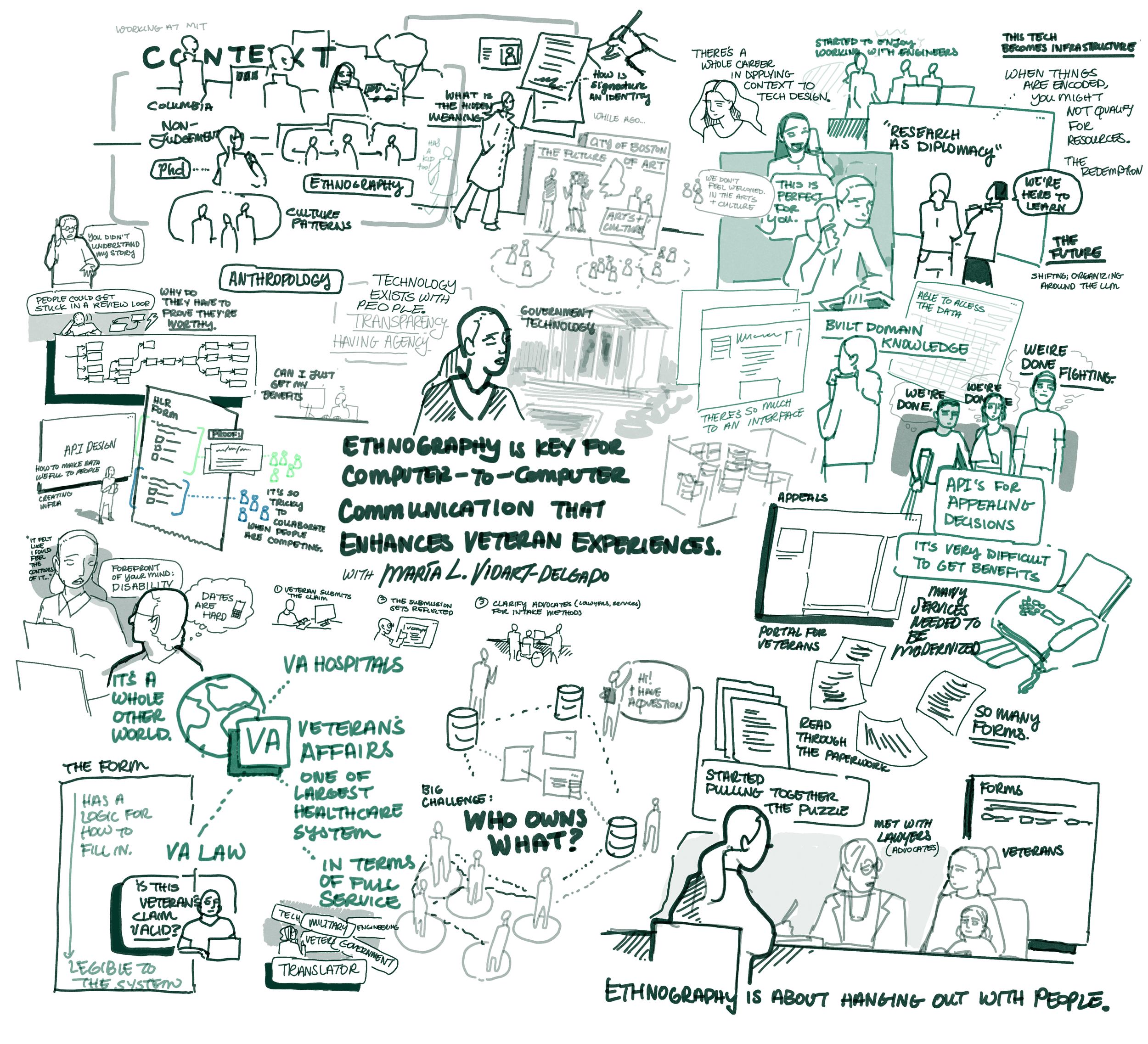
In this synthesis, Dr. Vidart-Delgado discusses the findings and impact of her work at the Department of Veterans Affairs. We focus the conversation on the piece she wrote: Ethnography is Key for Computer-to-Computer Communication That Enhances Veteran Experiences. Together we reflect on research as a kind of diplomacy inside large institutions and what LLMs and human labor each contribute to that work.
Read the original piece.
ANIMATIONS
PART 03: Modernizing Government Services
Chapter 02: Working with Veterans Affairs
Chapter 01: Introductions
ILLUSTRATION
TRANSCRIPT
Chapter 01: Introductions
Erin Murphy: How did you find yourself studying ethnography and anthropology?
Dr. María Vidart-Delgado: Yeah. So I've had a meandering career.
Erin Murphy: Nice.
Dr. María Vidart-Delgado: When I wrote this piece, I was working with a government contractor. That was my official gig as a UX researcher.
Erin Murphy: Excellent.
Dr. María Vidart-Delgado: Before that, I was in academia. I have an undergrad in anthropology. I grew up in Colombia, where there are 64 languages spoken. There are many indigenous groups and ethnic diversity.
And I was always fascinated by different ways of organizing society, different ways of processing reality, of seeing the world and understanding the world. So I studied anthropology, and ethnography is the main method, but it's also a theory.
And it looks at how groups of people make meaning. And how they organize the world around them. And it's marked by a suspension of judgment. Basically, like, as ethnographers, we are called to suspend our own judgment, and actually, for example, understand how certain values are produced, and ask why and explain why they're producing that way.
We are called to explain cultural patterns rather than emit our own judgments. So, that framework, like, that is the framework that I come with, like just that, the ethnographic framework that I come with to my own work, my own practice. I was in academia for a while.
I have a PhD from Rice University. I then went to MIT to do a postdoc in anthropology. And then there were no jobs.
Erin Murphy: How it goes.
Dr. María Vidart-Delgado: I had to figure something out.
Erin Murphy: I looked up a couple different descriptions of ethnography, and I don't think I got a... as compelling of an answer to "What is ethnography?" until you just described it now, of making sense... observing how other humans construct reality, and how other humans are making meaning from their worldview.
I think that's so much better than the weird clinical stuff I was finding on Google.
Dr. María Vidart-Delgado: Yeah, I think that in applied settings, there's a superficial definition of ethnography, which is not incorrect. If you go into kind of like this Socratic method of understanding — "What is context?", "Why?" — you get at the importance of context; the environment in which certain practices take place, and that those practices are shaping the context. So it's like really understanding how is environment, and what you're observing, related.
After I left academia, I started working with an urban planner and artist.
I was dressing in costume and kinda like doing public interventions in Boston, and kinda like studying how people relate to space, and it was amazing. This was kinda like my first time applying ethnography and seeing the application in real-world settings.
It's very helpful to understand how people's relationship to their neighborhood, the city. What is the hidden meaning of things that we take for granted?
We're going to be talking about veterans, which is highly bureaucratic. The VA government services are highly bureaucratic. Signing a piece of paper, to verifying identity, we don't think about it as much — but if you think about it... like, why do we sign a piece of paper? What does signature have to do with identity?
At a deeper level, you start answering the way that identity is constructed in our society, and how individualized it is.
Erin Murphy: Oh, that's so interesting. Yeah. Can you tell me a little bit more about the signature element? So why have we all subscribed to this idea that a signature is associated with identity?
Dr. María Vidart-Delgado: Okay... if you think about it, it's just we are scribbling something to verify that it's us.
Thinking from an ethnographer perspective — we act as kinda like, translators. We're encounter really foreign practices to us, we try to relate them, to explain them to the people, w— to our people, who... where we come from. That's what ethnographers do.
Erin Murphy: You had mentioned that you were working with an urban planner. Yeah. Was there any interesting kind of observations that you had during that time?
Dr. María Vidart-Delgado: Yeah. At the time, we were hired at some point by the city of Boston for the 10-year arts and culture plan — the first ever drafted for the city. Yeah. And our job was to engage people. We dressed up as gallerists from the future.
Erin Murphy: Oh, cool. Okay.
Dr. María Vidart-Delgado: People had to imagine what the future of Boston would look like, and they submitted it through our website into images.
Erin Murphy: Oh…
Dr. María Vidart-Delgado: We would go and print those images, and dress up as gallerists from the future, and hang them on the spaces that people reimagined. And we were walking around with a suitcase and big wigs and everything, and people would come and talk to us.
But one of the things about Boston is that it is incredibly segregated. The neighborhoods are very segregated, right? It's just like you have the Colombians in one neighborhood, the Dominicans, the Vietnamese... everyone is in their own little neighborhoods. That creates ideas of who belongs and who doesn't belong in different spaces.
For the 10-year arts and cultural plan was that in many ways everything is, like, all of the cultural services in Boston, or many of them, are located around downtown Boston, or what we conceive of Boston. But in places like Mattapan and Dorchester, which are down in the south, if you're not familiar with Boston... those neighborhoods are traditionally immigrant neighborhoods. There have been many waves of immigrants. There's like a Black and Latino populations in those neighborhoods, and folks didn't feel like they could access any of the cultural services — or art services.
It was like, "Hey, I may have my own cultural practice, artistic practices. I enjoy the arts. I do all of these things, but there's not place in the city for me to do that."
Erin Murphy: I think that kinda gives me a little bit clear of a picture of the community that you were having to observe.
Dr. María Vidart-Delgado: That was a while ago. That has started to change. You'll see kinda festivals in different parts of the city, and there's more kind of like a... yeah — there's more access to resources as well, from cultural organizations.
Dr. María Vidart-Delgado: So that was, like, when I was just leaving MIT. I had my daughter. We had a grant from ArtPlace America — we did that for 18 months.
And at some point, I was like, "Okay, I have a kid. What do I do? There's no academic jobs."
I worked for a nonprofit for a little bit as a web content manager, and that gave me an insight into basically how websites work. I was fascinated by websites. I started working with developers and everything, and I was just like, "Oh, this is so cool. The interface — there's so much to an interface, right?"
I started considering user experience, right? When you are making content for the web, you have to consider the experience of the user who's going to consume it. That was my "in" into UX.
I found this job as a UX researcher with this government contractor. A friend of mine from my PhD program called me, and she's, "Hey, I think you would love this type of job."
I ended up going to this government contractor, which, like, this company is still dear to my heart. I have like many friends who I met. They had a contract with the VA building the API platform for the VA, called Lighthouse. The whole idea was to expose VA data to a third party so they could build interfaces for veterans to transactions with the VA. It was opening up some of the data, and saying, "We're going to open it up, securely. We can build a healthy ecosystem of services that the government cannot build them by itself."
I was working mainly with engineers.
Erin Murphy: Okay.
Dr. María Vidart-Delgado: Which was a very cool experience. I thought at some point that I had nothing to do with a programmer, and then — I was like, "Oh, I actually understand how they think... And they understand how I think."
And then it was just like, "Oh, I got the disease." Like...
Erin Murphy: She caught the virus. I understand. I understand it well. Did you ever work with engineers prior to this, like software engineers?
Dr. María Vidart-Delgado: No. No. It was like I had like my... When I was working with a nonprofit, w— that was my first into working with engineers. It was the first time that I was kinda, like, working in an API, on an API platform.
The types of problems that I was researching was really understanding the context of use of data. We had to really understand how that data would be used in order for third parties to build anything that would be valuable. We needed to know the shape of the data.
So it was, for me, the first time that I had to kinda really think at that level of abstraction — which was really fun.
Chapter 02: Working with the VA
Erin Murphy: What was the first experience you had becoming familiar with the data that they were working with? I just know that there's like sometimes you have to become comfortable querying and looking through the data itself or assessing like the story the data's trying to tell.
Dr. María Vidart-Delgado: Yeah. So I am very comfortable asking dumb questions.
Erin Murphy: Yeah.
Dr. María Vidart-Delgado: I sometimes think that is my, my, my value.
Erin Murphy: Sure...
Dr. María Vidart-Delgado: So, in this professional settings, because I am not an engineer, I'm not a technical person...
I will kinda look into, "Okay, show me your screen, show me what you are seeing, what does this mean?" And then ask very basic questions about, again, Socratic method — but why? Why? Why? Why?
Erin Murphy: Yeah.
Dr. María Vidart-Delgado: And that helped me understand. At some point, I could read along. I knew what things meant. If I go into a GitHub repo, I could like piece together things.
I know where to look for things. We were keeping, for example, all of the research in the GitHub repo as well.
I had to understand as well how to call an API, what goes into calling an API, how you build an API, right?
Erin Murphy: Yeah.
Dr. María Vidart-Delgado: I am not... I d— never an expert. I see. Just dumb question.
Erin Murphy: So just really entering the scene with a lot of curiosity and getting people to open up the domain for you.
Dr. María Vidart-Delgado: Yes. And it was like, the domain was very difficult, it was challenging for me.
Erin Murphy: Yeah.
Dr. María Vidart-Delgado: But that's what I love. Yeah... because of the technical aspect, but also the bureaucratic a— aspect. The VA is a monster.
Erin Murphy: Oh!
Dr. María Vidart-Delgado: It is a monster of an organization, right? It's one of the largest employers in the US.
Erin Murphy: Wow.
Dr. María Vidart-Delgado: The VA healthcare system serves something like 9 million people. I don't know how much it is.
Erin Murphy: Yeah. Okay.
Dr. María Vidart-Delgado: Yeah, it's like the largest healthcare system in the country other than Medicare and Medicaid, right?
Erin Murphy: Yeah.
Dr. María Vidart-Delgado: There are all of the benefits and the appeals, lawyers who specialize in veteran law. It is a whole world. Even like a tiny part of the system was incredibly complex.
So there was a lot of talking to the engineers, as well talking to the bureaucrats, the people help me understand the nuances of the process so that we can understand what data to expose.
Erin Murphy: So just to get this right, though, the Veterans Affairs organization is the largest healthcare system in the US.
Dr. María Vidart-Delgado: US. I think it's just, it's the largest, in terms of full service.
Erin Murphy: Yeah.
Dr. María Vidart-Delgado: Full service, because people who have VA healthcare, yeah... they have everything. It's just like they have access to the VA hospitals.
Erin Murphy: Yeah. ...and that is different from Medicare and Medicaid, which is like an insurer. Okay, that's great. I wanted to kinda capture that 'cause I was slightly new to the concept of ethnography, and then I also felt like I needed to do a little bit of research on my own to really understand 'Veterans Affairs.'
I have a whole section I'm pulling together of the experience of working with the engineers and the technical team at the VA.
Can you speak to the day in the life of a user? I'd like to learn more about what is the day in the life of a veteran using the API for disputing a pension or compensation or decision?
Dr. María Vidart-Delgado: Yeah. Man, that was very difficult. So I was working building the APIs for appealing decisions.
Erin Murphy: Okay. What does that mean? So... yeah.
Dr. María Vidart-Delgado: Appealing a decision: veterans, when they join, when people join the military, they're promised a lot of benefits.
Erin Murphy: Yeah.
Dr. María Vidart-Delgado: Sometimes people come back from being deployed in bad shape. And they become disabled. And some, after serving their country, come back and they find they have to fight the government to get their benefits because their benefits are denied.
So they have to appeal. There's a higher court of the VA. The VA appeals, where they appeal the initial decision. They review, and then they make a decision.
They're applying to their benefits because people coming back to apply to the VA benefits, especially for disability benefits, they really need them. They're not applying because for fun. Folks really need them.
Erin Murphy: Yeah.
Dr. María Vidart-Delgado: So they come and fight the government and it's exhausting. It is absolutely exhausting.
They're working with all of these, uh, advocates; these veteran service organizations, what are called VSOs.
Erin Murphy: Yeah.
Dr. María Vidart-Delgado: Like for example, the American Legion.
They have physical spaces in cities where they have bars, restaurants, people go to hang out, to provide support for veterans, but they also have representatives that help them apply to benefits and receive the benefits.
Erin Murphy: I see.
Dr. María Vidart-Delgado: They have all of these advocates that help them because the system is so bureaucratic. It's so process intensive. There's so many things to pay attention to. You have to file claims in very specific ways. You have to provide very specific medical evidence. What counts as evidence is not just anything. That information has to provided in a specific format that can be legible to the VA.
So for a veteran, that is very confusing. It can be... It's very difficult. These service organizations help them put all of their life story in a format that is legible to the VA.
Erin Murphy: I don't think that I appreciated and understood, like, how much of a uphill battle it was to just get the benefits that were promised you.
But this is like, as you went into the service, you were promised these certain benefits. And I've... yeah, obvious statement, but it... You shouldn't have to fight for those things.
Dr. María Vidart-Delgado: You shouldn't have to fight for any of that, right?
Erin Murphy: Yeah, absolutely not.
Chapter 03: Modernizing Government Tech
Erin Murphy: What was the tooling that they had to use originally?
Dr. María Vidart-Delgado: Before, everything was done by fax.
Erin Murphy: No, not the fax machine. Sorry, I was once a secretary admin at a college and I had to fax things over. That was a nightmare.
Dr. María Vidart-Delgado: The government has been working very hard. This has been a while, right? We are in a very different state of government right now.
Erin Murphy: Sure.
Dr. María Vidart-Delgado: But since the Obama years, there has been, like, an effort to modernize government services and to digitize things. There was, like, an act called the Paper Reduction Act as well.
Erin Murphy: Wow.
Dr. María Vidart-Delgado: With forms, all of that was inc— incredibly difficult. So all of these government agencies started modernizing their services.
The API platform was part of this effort to reduce these transactions that were made by paper. And they even put together for the veterans a veteran portal, where they could submit their claims, apply for their benefits, track their benefits.
All of this was part of that larger effort. Specifically with the appeals... there was this system that was built by one guy. His name is Ned. It was an intake system that would intake from fax to VA databases.
Erin Murphy: Wow.
Dr. María Vidart-Delgado: And Ned was about to retire.
Erin Murphy: Oh, no.
Dr. María Vidart-Delgado: And the motto of all of the teams that were working on that project was, like, "Let Ned retire." Because he was the sole maintainer of the system, and everyone was work— we need to—
Erin Murphy: turn Ned into a service.
Dr. María Vidart-Delgado: Yeah, and everyone was working toward 'Let Ned retire.'
Erin Murphy: Oh my God.
Dr. María Vidart-Delgado: We all were just hoping that he's enjoying his retirement, because that guy worked so hard. For veterans to get a decision, it would be like you would send something and it's sent into a black box. There's no way of tracking it. There's no transparency. You fax something over, then you get a receipt, uh, of when it was sent and that was it.
Erin Murphy: Wow. That's crazy.
Dr. María Vidart-Delgado: Over the course of many years that this has changed, and I was working again on one very specific thing, trying to make it more transparent, right?
It's just if you're imagining the anxiety of just knowing that you need certain benefits, appeal certain benefits, and not knowing what's happening with that.
Erin Murphy: Without some kind of technology, people didn't really have an awareness of like where their benefits were in the pipeline of being available. Is that what you're saying?
Dr. María Vidart-Delgado: Yeah.
Erin Murphy: Okay.
Within the world of the VA, what were some of the challenges of modernizing government techno— technologic infrastructure, and how did you apply ethnography to help you unpack those challenges?
Dr. María Vidart-Delgado: Yeah, like at the VA is a giant bureaucratic system. There are many teams touching different parts of the system and different owners. There's like gatekeepers, right? That would kickstart like a whole conversation about ownership, having access, what is the shape of the data? What does an endpoint look like? Is it just like a Word document?
Erin Murphy: Yeah.
Dr. María Vidart-Delgado: Having that like deep understanding of the system was incredibly challenging. Not only the technical system, but the relationships that go into it.
Erin Murphy: Yeah.
Dr. María Vidart-Delgado: We wrote a short blog post about this: 'research as diplomacy.'
Erin Murphy: Interesting.
Dr. María Vidart-Delgado: We talk to database owners, and it was like, "Oh, yeah, we're doing research. I am the researcher." We would approach again, like with this ethnographic mindset of just no va— no value judgment.
Erin Murphy: Yeah.
Dr. María Vidart-Delgado: We're here to learn with deep curiosity, and also say, "Hey, we're trying to do this, we are trying to understand how you do things."
And we would win people over.
It allowed us to say, "Okay, there's probably a way to connect to your database."
Erin Murphy: I've never thought about research as diplomacy, but now I can't unsee it. It's a neutral way to unpack those relationships. It's "We're just here to learn." Yeah. It's not like we need to have some kind of hierarchy of knowledge. We just want to understand how this system works.
Dr. María Vidart-Delgado: Yeah, and there's...
That's something that, that's a skill that I've developed more during my time at the VA, but I've taken with me. At Reddit now — it happens. The organization, you have different teams, sometimes, like, tricky political relationships because people have different perspectives. And there's scarce resources, and there can be arguments, disagreements.
We're trying to do different things. Let's understand what each team is trying to do, approach it with curiosity. Where's the overlap, where is the disagreement, and let's take it from there.
I do think it's shaped by anthropology: understanding someone's perspective in their own terms. It's not what I want them to understand. It's just let me understand 'why.'